 Opensea
Opensea offers and their expiry deadlines
Updated -
Opensea offers expire at the end time chosen when the buyer creates the bid. Sellers must complete acceptance while the offer remains valid. Cancellation or an earlier purchase can end availability before that deadline. Ethereum bids rely on available wallet funds, while Opensea-created Solana offers hold the purchase amount onchain until the offer ends.
An item bid, a collection offer, and a trait offer target different sets of NFTs. Their deadlines limit acceptance, while funding and cancellation rules determine what happens around that deadline.
The signed deadline controls Seaport settlement
The Seaport trading protocol includes start and end times in signed Ethereum NFT orders, making expiry part of settlement validation. A Seaport order remains within its time window only while the executing block’s timestamp precedes its end time and reaches its start time. The countdown on an item page represents that timing, and the contract applies the signed terms when the transaction executes.
A seller can submit acceptance before the deadline and still miss it if execution arrives too late. Submission puts the transaction in progress, but an expired Seaport order cannot settle through ordinary fulfillment. Reusing the original signature does not create a fresh acceptance window, because it still describes the same expired terms.
Seller acceptance and the completed sale
A seller accepts an active bid through the item page, profile, or relevant collection view. The acceptance flow displays expected proceeds before confirmation, allowing the seller to assess deductions from the offered amount.
The owner must still control the NFT and authorize its transfer. For an Ethereum NFT, a required transfer approval permits the relevant contract to move the asset without itself accepting a particular sale price. For a listed Solana NFT, Opensea includes listing cancellation in the acceptance flow and may request two signed transactions.
For Ethereum offers, the wallet authorizes an acceptance transaction that executes through Seaport only if timing, funding, approvals, and order status permit fulfillment. A signature or pending transaction alone leaves completion unresolved.
Successful settlement transfers the NFT and distributes payment under the order’s terms. Transaction confirmation and the resulting ownership and payment records establish the sale. An updated offer display accompanies those blockchain changes; a submitted transaction identifier alone does not establish them.
An acceptance that fails leaves the purchase incomplete, although an unsuccessfully executed transaction can still consume gas.
How long can item and collection offers last?
The standard Ethereum item-offer and collection-offer forms default to 30 days and allow a maximum duration of six months. Buyers can change the duration before submitting the bid. That default is not every offer’s actual deadline, and it does not establish limits for a separate chain-specific flow. The individual offer’s expiry governs its acceptance window independently of any change to the seller’s listing duration.
Item bids, collection demand, and trait restrictions
Bids for a particular NFT
An item offer targets a specified NFT, while the bulk-offer flow creates separate bids on selected items from the same collection. Each selected item has its own offer amount. Grouping those bids saves entry work, while each retains its own purchase terms. Independent item bids therefore expose the buyer to a different set of possible purchases from a single collection offer.
Offers that eligible owners can accept
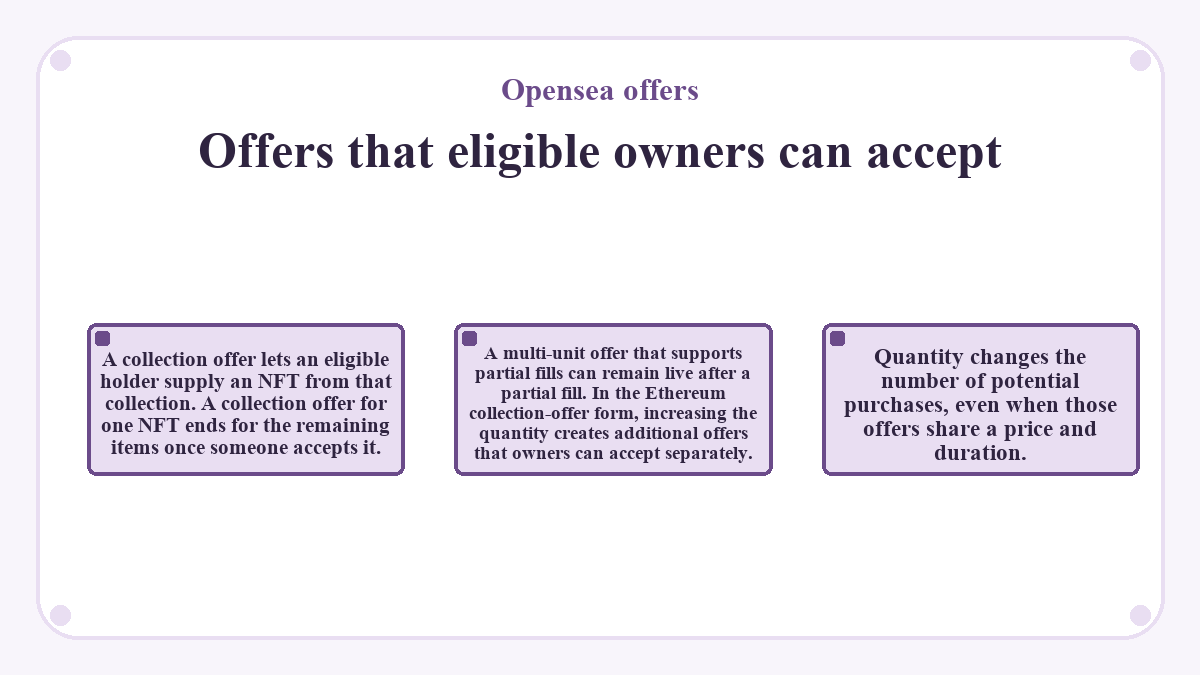
A collection offer lets an eligible holder supply an NFT from that collection. A collection offer for one NFT ends for the remaining items once someone accepts it. A multi-unit offer that supports partial fills can remain live after a partial fill. In the Ethereum collection-offer form, increasing the quantity creates additional offers that owners can accept separately. Quantity changes the number of potential purchases, even when those offers share a price and duration.
Selection by metadata traits
Where trait offers are enabled, a buyer can limit a collection bid to NFTs matching up to two traits from different categories. Some trait offers fix their eligible NFT set when created; others check the NFT’s traits when generating fulfillment data. Later metadata changes can therefore affect eligibility or the traits that a purchased NFT has. Availability depends on collection support, and trait offers are not currently enabled for Solana collections.
Wallet funds on Ethereum and held funds on Solana
Ethereum bids authorized against wallet balances
Wrapped Ether (WETH) supports pre-authorized NFT bids on Ethereum, allowing a seller to fulfill an offer without another signature from the buyer. The funds remain in the buyer’s wallet until acceptance, and fulfillment requires sufficient token balance and transfer permission.
ETH and WETH are different wallet balances, so holding ETH for network fees does not supply the WETH that an offer requires. Spending the bid currency can make an outstanding bid unfunded.
Solana offers with committed purchase funds
An Opensea offer on Solana holds its purchase amount onchain until the offer ends. Collection settings determine the currency, including SOL or USDC, and the currencies cannot be substituted. The same committed funds cannot back multiple simultaneous offers.
Why can an unexpired offer become unavailable?
An unexpired Seaport offer can fail because its funds, transfer approvals, asset availability, or order status no longer support the trade. The expiry defines the end of its time window without establishing that every other requirement remains satisfied until then.
An unfunded Ethereum collection offer can become active again when the buyer restores enough WETH, provided the order remains otherwise valid. Removing funds therefore changes funding status without necessarily canceling the signed order. Someone intending to withdraw a bid needs cancellation, because replenishing the wallet may make the outstanding offer fulfillable again.
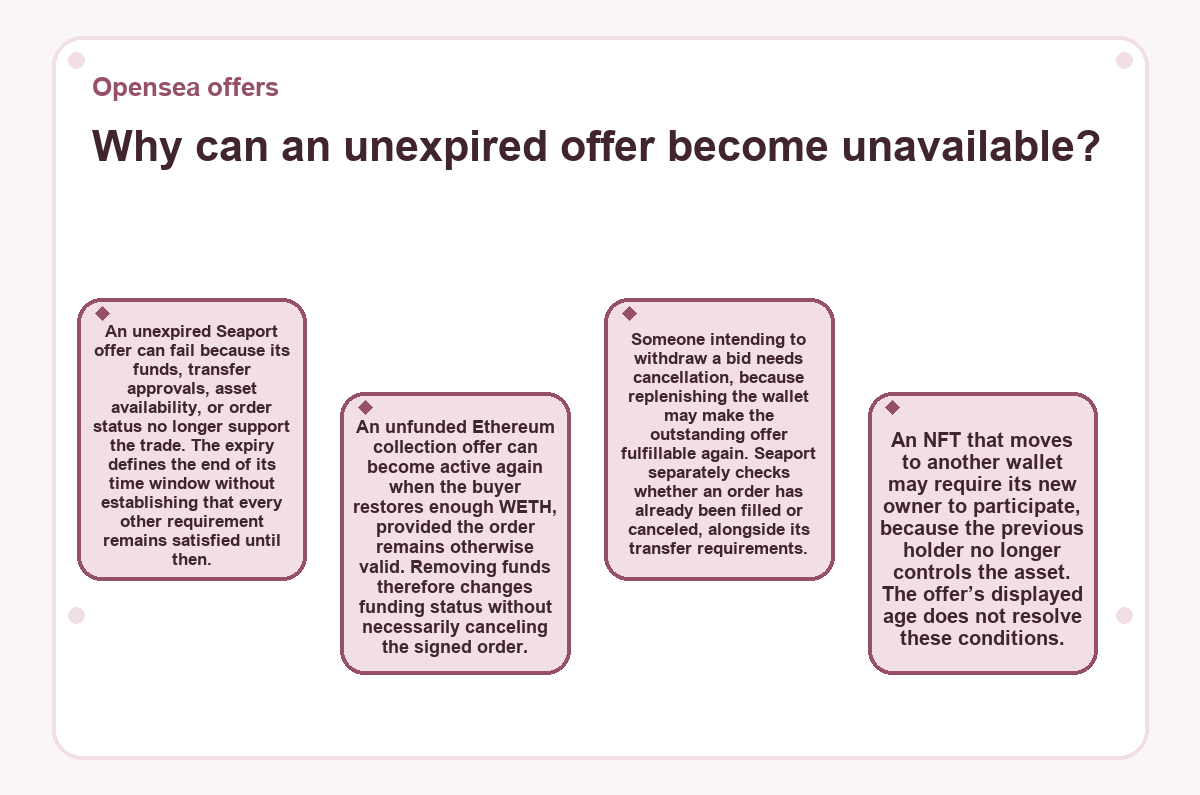
Seaport separately checks whether an order has already been filled or canceled, alongside its transfer requirements. An NFT that moves to another wallet may require its new owner to participate, because the previous holder no longer controls the asset. The offer’s displayed age does not resolve these conditions.
Gas-free cancellation and onchain invalidation
Cancellation can end a bid before its scheduled expiry, with different finality and costs across the supported mechanisms. Some recently created Seaport offers may require onchain cancellation.
Protected Seaport orders
Gas-free cancellation stops new fulfillment authorizations for orders protected by Seaport’s signed zone, which checks permission before allowing a fill. An already issued fulfillment signature can remain usable for up to five minutes after its issuance. That interval starts when the signature is issued, so cancellation does not start a fresh five-minute window. The order’s own expiry can end availability sooner.
Transactions that cancel the order
Onchain Seaport cancellation costs gas and invalidates the order when the transaction succeeds onchain. While that transaction is pending, the order may still be fillable. The protocol exposes a canceled status for the specific order, giving a concrete check beyond the submitted transaction identifier. Cancellation cannot reverse an order that settled before it took effect.
Cancellations of Opensea-created Solana offers require individual signed onchain transactions with network fees.
An offer awaiting cancellation
Assume an unfilled bid remains within its duration and supports gas-free cancellation. The buyer requests cancellation, and the interface indicates that cancellation is pending. The next action depends on whether an earlier fulfillment authorization remains usable and whether the buyer wants to wait.
- If the bid has already completed, review the purchase record; cancellation cannot undo that purchase.
- If cancellation remains pending and waiting is acceptable, allow the outstanding fulfillment authorization to expire.
- If stopping further acceptance sooner matters, select the available onchain cancellation, review its network fee, then sign and submit the transaction.
- If a cancellation transaction is pending, keep treating the bid as potentially fillable.
- After an onchain cancellation succeeds, check that this particular order has a canceled status.
A canceled onchain status blocks further fills of the original order; gas-free cancellation becomes effective after outstanding fulfillment authorizations expire. If the offer expires first, its time window already blocks further acceptance. If another transaction fully fills it first, the relevant record is a completed purchase. Read that changed outcome before submitting another cancellation.
What happens to the purchase funds after expiry?
Expiry leaves an unaccepted Ethereum offer’s WETH in the wallet and releases funds held for an Opensea-created Solana offer shortly afterward. Ethereum’s signed-bid mechanism does not need a purchase-amount refund because placing the bid did not transfer that amount. Solana’s automatic return concerns the held purchase funds. The Solana account deposit returns automatically to whoever paid it when the offer ends; network fees are not refundable.
Fees and payments behind the displayed bid
An offer amount describes the proposed purchase payment; seller proceeds reflect the deductions that apply to that trade. Platform fees and creator earnings, often called royalties, can reduce the amount that reaches the seller. Those deductions belong beside the bid’s currency and expiry when assessing whether acceptance meets the seller’s terms.
For Solana offer acceptance, the platform fee and applicable creator earnings come out of the offer amount. This differs from a direct Solana purchase, where creator earnings can be added to the listed price. Network fees and the refundable account deposit for creating an offer remain separate from its purchase amount. These setup amounts use SOL even when the collection’s purchase currency differs.
Ethereum buyers may need a token-approval transaction before making offers in a currency for the first time. Sellers pay network fees when accepting offers. A bid’s expiry does not erase transaction costs that arose while setting up or attempting the trade. The wallet’s proposed transaction shows the estimated network cost for that action.
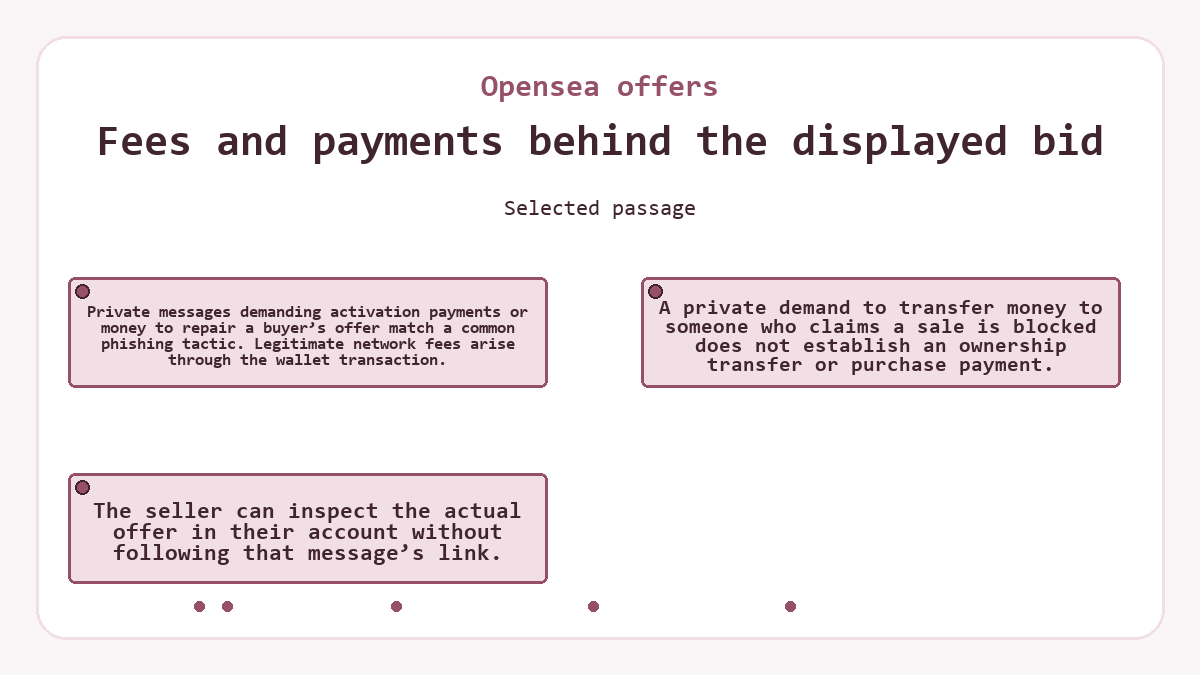
Private messages demanding activation payments or money to repair a buyer’s offer match a common phishing tactic. Legitimate network fees arise through the wallet transaction. A private demand to transfer money to someone who claims a sale is blocked does not establish an ownership transfer or purchase payment. The seller can inspect the actual offer in their account without following that message’s link.
Opensea offers: the short answers
Can an NFT receive an offer before its owner lists it for sale?
An NFT can receive an offer even when its owner has not listed it for sale. The owner can accept or ignore the bid. An offer on an unlisted item is a proposed purchase, and the owner’s acceptance determines whether it becomes a sale. Its own expiry still limits how long that proposal remains available.
Does the highest bid win automatically when an ordinary offer expires?
An ordinary item or collection offer does not become a purchase merely because it is the highest bid at expiry. It requires acceptance while valid. Expiry ends that opportunity if nobody completes acceptance. Matching or exceeding a seller’s asking price also does not itself fulfill an offer; the buyer’s bid remains a separate order.
What changes when I submit a new bid on the same Solana NFT?
A new bid on the same Solana item replaces your existing offer on that item. It does not create an additional active bid alongside it.
Where can I cancel a Solana offer that originated on another marketplace?
Cancel a Solana offer on the marketplace where you created it. Opensea can display those offers, but it cannot cancel them for you.
Why might a Solana collection lack collection-wide bidding?
Solana collection offers are unavailable for very large collections or collections that use multiple onchain collection addresses. An available collection offer covers only the grouping against which it was made.
Is a collection offer valid for an NFT disabled for suspicious activity?
A collection offer is not valid for an NFT that Opensea has disabled for suspicious activity. An unexpired deadline does not override that restriction.
Can I choose creator earnings when placing an item offer?
When creator earnings are optional but specified for the collection, the item-offer form lets the buyer choose whether to include them. That option does not establish that creator earnings are optional for every collection. The offer review shows the terms that the buyer is about to authorize.
Will completing one bulk-created item bid cancel all my other bids?
Completing one bulk-created item bid does not by itself cancel the other item offers, which are separate orders. An accepted purchase can reduce the wallet’s funding for remaining Ethereum bids, making them unfunded. Those offers retain their own terms and may become usable again if funding returns before expiry.