 Opensea
 NFT trading, token swaps, and cross-chain purchases
Updated -
Opensea combines peer-to-peer NFT trading with token swaps, with cross-chain purchasing available for eligible assets. NFTs are blockchain tokens that identify particular items or editions. An NFT purchase transfers an item or quantity, while a swap exchanges cryptocurrency balances. Listings establish seller terms, and swap quotes estimate an exchange through available liquidity. Wallet permissions and the network govern authorization and settlement.
In this guide
The OS2 rebuild brought marketplace aggregation and token trading into the same interface. Collection browsing, fixed-price purchases, offers, creator tools, and swaps have different requirements. A wallet connection alone does not establish compatibility with every asset or payment route.
Bottom line: Eligible cross-chain checkout can use existing wallet funds on another network, avoiding a separate manual bridge before an NFT purchase.
NFT listings, connected wallets, and swap liquidity
NFT listings describe items, quantities, prices, and sale durations; connected wallets authorize orders and transactions. Collection pages organize artwork, gaming items, membership passes, and other supported NFTs. Search and statistics filters narrow results by chain, category, and timeframe. Pro mode emphasizes compact market data and depth charts, while Collector mode gives artwork and collection descriptions more space. On Ethereum-compatible networks, the contract address and token identifier distinguish a specific NFT from another item with similar artwork or a matching name, making them useful when examining a purchase.
Seaport is the smart contract protocol used for NFT orders on supported Ethereum-compatible networks. Solana NFT trading uses a separate marketplace program and covers selected collections. Trading actions depend on the NFT standard; some items are visible but cannot be bought, listed, or offered on. Token swaps can use routing services including Relay, Jupiter, LiFi, and 0x. These integrations source liquidity for cryptocurrency exchanges, while NFT orders specify the assets and payment terms of a sale.
Buying and selling listed NFTs
Buying a listed NFT accepts the seller’s price, while sellers can publish listing terms or accept an existing offer. Item and collection views both support purchases. Checkout identifies the asset and payment currency before the wallet presents authorization. Multi-item purchases can require separate transactions when their orders use different contract versions, allowing some purchases to succeed while others fail.
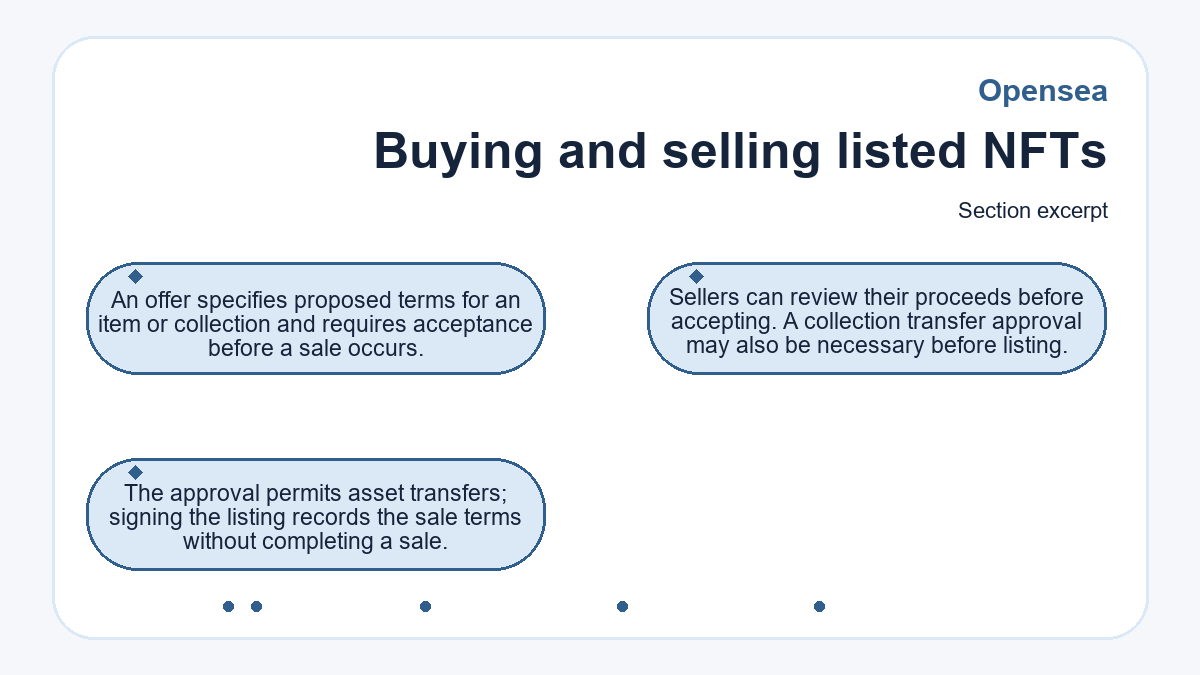
An offer specifies proposed terms for an item or collection and requires acceptance before a sale occurs. Sellers can review their proceeds before accepting. A collection transfer approval may also be necessary before listing. The approval permits asset transfers; signing the listing records the sale terms without completing a sale.
Creator earnings, commonly called royalties, can be optional or enforced for a collection. Their treatment affects the seller’s proceeds.
A fixed-price listing has a duration and conditions that govern fulfillment. Review active and inactive listings when changing a price or deciding not to sell. An inactive listing can become fillable again if the item returns to the wallet and its original order conditions still hold. Cancel inactive listings that you no longer want filled. Eligible ERC-721 price reductions can be gas free, while cancelling a listing can require an onchain transaction. A request from an unsolicited buyer to send extra funds to repair a failed sale is a common phishing attempt.
Token quotes, liquidity, and slippage
Token swaps exchange supported cryptocurrency amounts using quotes sourced from available liquidity. The swap screen identifies the sending token, receiving token, and relevant networks. The swap page and wallet sidebar offer general access; individual token pages focus on the selected token.
Swap impact reflects the price movement that the trade’s size causes relative to liquidity. Slippage tolerance limits acceptable price changes before execution. Higher tolerance permits greater deviation from the quote and can increase exposure to transaction ordering that worsens the received amount.
Ethereum Virtual Machine (EVM) swap rates include fees, while Solana swap fees are additive. Gas sits outside both displayed exchange rates. These pricing conventions affect the total cost, so the estimated receiving amount needs to be read alongside the fee breakdown.
A displayed quote remains an estimate until the transaction executes within its permitted price conditions.
Cross-chain checkout eligibility
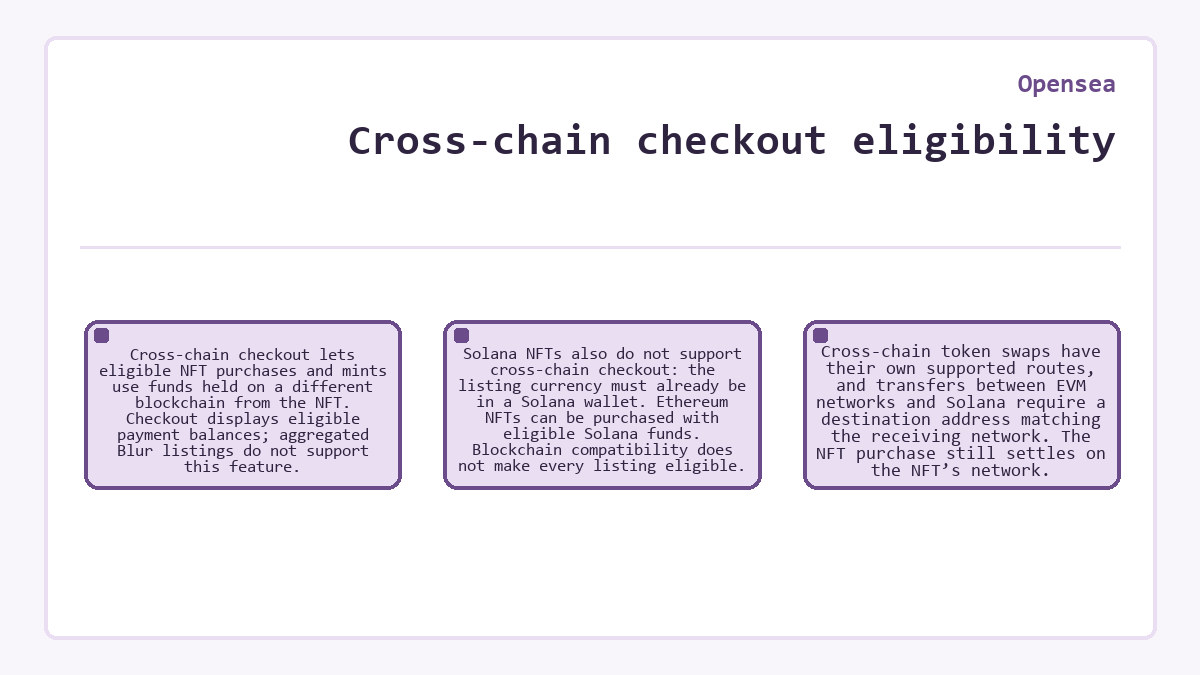
Cross-chain checkout lets eligible NFT purchases and mints use funds held on a different blockchain from the NFT. Checkout displays eligible payment balances; aggregated Blur listings do not support this feature. Solana NFTs also do not support cross-chain checkout: the listing currency must already be in a Solana wallet. Ethereum NFTs can be purchased with eligible Solana funds. Blockchain compatibility does not make every listing eligible. Cross-chain token swaps have their own supported routes, and transfers between EVM networks and Solana require a destination address matching the receiving network. The NFT purchase still settles on the NFT’s network.
Minting collections with Studio
Studio supports NFT creation through collection contracts, including direct minting into a wallet and public drops. Solana NFT creation and Solana drops are not supported. Its direct collection creation path deploys an EVM contract before minting items. That path produces ERC-1155 tokens and supports multiple copies of an item, with gas charges for contract deployment and minting.
A drop makes NFTs available for other people to mint under its configured release conditions. Creating an NFT publishes the token; listing it for resale is a separate action. Contract names and symbols become fixed after deployment in the direct creation flow, while Studio supports later edits to specified media and metadata fields.
What costs apply to NFT trades and token swaps?
NFT trades can involve platform charges, creator earnings, and network gas, while swaps can also involve routing provider fees. Standard NFT sales typically carry a platform fee of 1% of the sale price. This fee is included in the price displayed to buyers. Primary drops typically carry a 10% platform fee, and the platform fee for swaps is currently 0%. Provider and network costs can still apply. Fees can change, and listing or offer fees are set when the order is created.
Network charges depend on the chain and transaction. An external wallet usually needs the chain’s native token for gas. Email-login wallets can pay gas with supported stablecoins when their smart-account feature is enabled on a compatible chain. This option requires a one-time delegation for each supported chain, bundled into the first qualifying transaction. Connected external wallets are ineligible for this specific stablecoin gas feature. The selected payment method still needs sufficient funds for the trade and its network costs.
To buy a particular NFT with existing wallet funds, compare checkout eligibility with the alternative of a token swap. A swap changes the available payment balance; eligible cross-chain checkout can fund the NFT purchase directly.
- Match the NFT’s chain, asset identifier, and quantity to the intended purchase. For EVM NFTs, check the contract address and token identifier.
- Use the listed currency when checkout accepts the existing balance on that network.
- Choose cross-chain checkout only when the selected listing and payment token qualify.
- Choose a supported swap quote for the listing currency on the NFT’s network when a different payment token is needed, retaining funds for applicable gas.
- Read the receiving amount, slippage limit, and provider costs before approving a swap.
NFT ownership, edition balances, and perpetual positions
NFT ownership concerns specific tokens or edition quantities, while perpetual contracts track leveraged market exposure through a separate trading account. A submitted transaction or signature alone does not demonstrate purchase completion. Successful network execution and the resulting asset ownership or balance establish whether the trade completed.
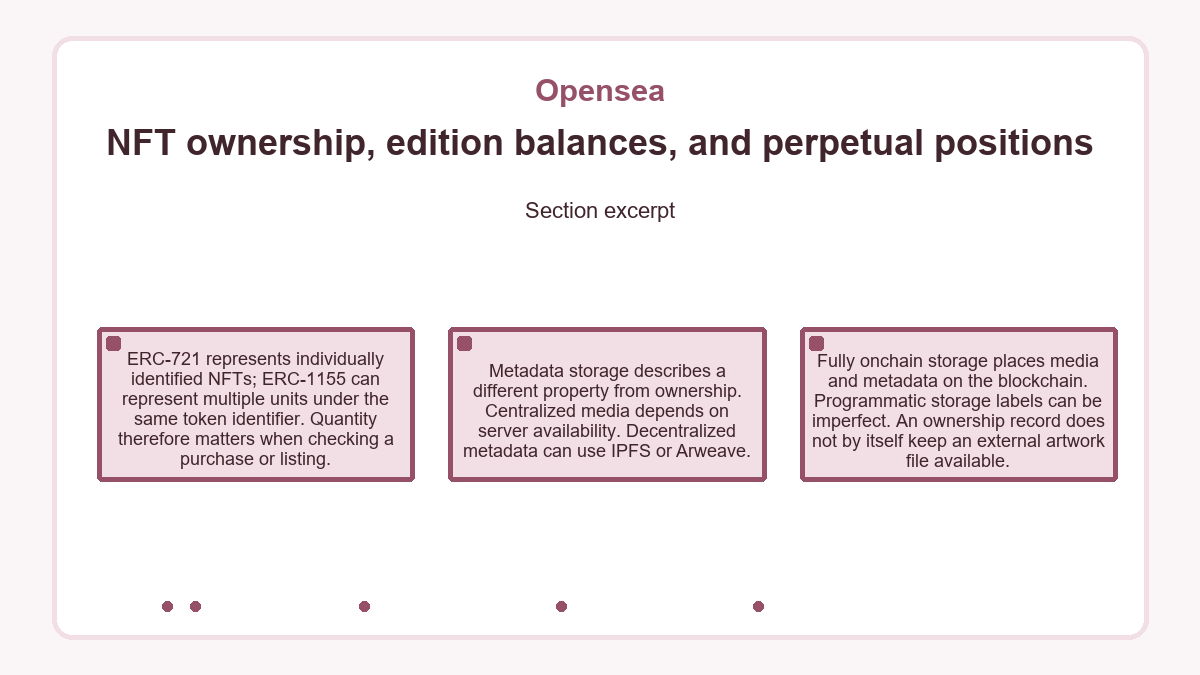
ERC-721 represents individually identified NFTs; ERC-1155 can represent multiple units under the same token identifier. Quantity therefore matters when checking a purchase or listing. Metadata storage describes a different property from ownership. Centralized media depends on server availability. Decentralized metadata can use IPFS or Arweave. Fully onchain storage places media and metadata on the blockchain. Programmatic storage labels can be imperfect. An ownership record does not by itself keep an external artwork file available.
The mobile app brings token trading and portfolio views to iOS and Android. If the app presents a waitlist, a referral code provides immediate access. The mobile web interface is an alternative. Perpetual trading uses Hyperliquid positions backed by USDC collateral. Some features may roll out in phases; trading is unavailable in the United States, the United Kingdom, and US-sanctioned countries. Leverage adds liquidation risk, so derivatives require different funding and monitoring from owning tokens outright. Hyperliquid maintains the underlying perpetual position records.
Opensea: the short answers
Is card funding available everywhere on Opensea?
Card funding depends on the regions that the integrated payment provider supports. MoonPay can supply cryptocurrency to a wallet using a credit or debit card in eligible regions. Its processing fees and identity checks are separate from NFT marketplace charges. The provider handles identity verification, and Opensea does not store those details. Funding a wallet buys cryptocurrency; it does not automatically buy a selected NFT.
Why is an NFT missing from my Opensea profile?
A missing NFT can reflect the wrong connected wallet, an unfinished transaction, or a marketplace delisting. The connected address and transaction status help distinguish these situations. Delisting removes the item from marketplace visibility while its blockchain record remains. A profile display alone therefore does not establish whether a purchase failed or ownership changed.
What does a blue collection badge mean on Opensea?
A blue collection badge means that the collection belongs to a verified account and has significant interest or sales. The badge is not an endorsement or recommendation. Eligibility criteria can change, and an existing badge does not necessarily show that a collection satisfies later requirements.
Will I recover gas if an NFT purchase fails?
Gas spent processing a failed blockchain transaction is not refundable. The charge pays for network processing even when the transaction cannot complete the purchase. Opensea does not receive those network fees and cannot return them. The transaction receipt identifies the failure status and the gas charged, distinguishing processing costs from the NFT sale price.
Can I change the email address used for my email-login wallet?
An email-login wallet is tied to its original email address, which cannot be changed within that account. Using another email requires creating a different account. A profile’s marketing or notification email has a different purpose from the address that controls email-wallet login.